GCPR VMV | 2026
GCPR VMV 2026
GCPR +VMV 2026 Program
Below you find the program of the conference. A pdf version is downloadable here.

Tuesday, September 22
12:30 - 15:00 Women in Vision Workshop at GCPR 2026 (US-C 105)
Organizers: Dr. Natacha Kuete Meli (University of Siegen), Prof. Michael Moeller (University of Siegen)
The Women in Vision Workshop at GCPR 2026 aims to celebrate the impact of women in the field, promote visibility, and foster inclusiveness and diversity in pattern recognition and related research areas. The workshop provides an opportunity for early-career researchers and talented women scientists to connect with one another. Finger food and coffee will be provided to enrich the discussions. Note: While the workshop is intended for women as active participants, people of all genders are warmly welcome to attend.
- 12:30–12:35 Opening
- 12:35–12:50 Dr. Joana Grah: Women in Science
- 12:50–13:15 Prof. Zorah Lähner: Geometry in 3D Gaussian Splatting
- 13:15–13:40 Dr. Rachel Hegemann: Regulation and Research: Can the AI Act Bring New Research Opportunities?
- 13:40–13:45 Preparation for the mentoring session
- 13:45–14:30 Mentoring session with mentors Dr. Natacha Kuete Meli, Dr. Joana Grah, Prof. Zorah Lähner, and others to be announced.
- 14:30–15:00 Poster session
About the Speakers
Dr. Joana Grah (Robert Koch Institute, joanasarahgrah.science) is a Research Associate in applied mathematics at the Robert Koch Institute. She holds a PhD in Applied Mathematics from the University of Cambridge, UK. Beyond her research, she actively advocates for equal opportunities and feminism to support science in diverse, interdisciplinary, and empathetic environments. She is a co-founder of “Her Math Story,” (https://joanasarahgrah.science/index.php/her-maths-story/) a platform showcasing the stories of women mathematicians across a wide range of careers, non-linear paths, and individual decision-making processes.
Prof. Zorah Lähner (University of Bonn and the Lamarr Institute, geometryinml.cs.uni-bonn.de/team/zorah/) has been a full professor at the University of Bonn and the Lamarr Institute since 2026, where she leads the Geometry in Machine Learning group. She obtained her PhD in Computer Science from the Technical University of Munich. Her research focuses on geometric aspects of optimization, including geometric deep learning and 3D geometry processing.
Dr. Rachel Hegemann (Deutsche Bahn AG) is a Data Scientist at Deutsche Bahn AG. She holds a PhD in spatio-temporal social networks and data reconstruction from the University of California, Los Angeles. Her current work focuses on developing assessment and testing strategies to ensure AI safety and quality in industrial applications.
Contact: natacha.kuetemeli@uni-siegen.de
15:30 - 18:30 Tutorial on Scaling Open-source Vision Foundational Models (US-C 114)
Organizers: Shashanka Venkataramanan, Lukas Knobel
Workshop session: Half day, Tuesday afternoon
Vision foundation models trained on massive, proprietary datasets currently dominate the field, creating a significant barrier for the broader research community. This tutorial shifts the narrative, demonstrating how researchers can train vision encoders entirely on open-source datasets to match or even surpass the performance of closed-source giants. We move beyond theoretical assumptions to break down the exact engineering requirements needed to close this gap whether you are working with a massive cluster or a multi-node setup.
Scaling models introduce severe optimization challenges, from loss spikes to representation collapse. We detail how to maintain training stability when moving to a few hundred million parameter model, but we also translate these lessons into practical strategies for smaller-scale training. By monitoring gradients and architectural bottlenecks, researchers can ensure steady convergence and faster training times, regardless of their total FLOPs budget.
The most significant lever for performance isn't just more compute, it’s better data. Moving away from indiscriminate web scraping, we examine how advanced filtering strategies such as semantic deduplication and entropy-based sampling directly dictate a model’s zero-shot transfer capabilities. These techniques allow researchers to achieve superior feature quality with a fraction of the data, making high-performance training accessible to those without petascale storage.
What this tutorial aims to achieve:
- Demonstrate how vision encoders trained exclusively on public data (like DataComp or LAION) can achieve parity with proprietary models across standard benchmarks.
- Provide architectural and hyperparameter strategies to maintain steady convergence when scaling vision foundation models.
- Teach algorithmic data filtering techniques that shift the focus from raw data volume to high-quality, balanced datasets, effectively improving model robustness.
- Bridge the gap between "big lab" infrastructure and academic research, providing a roadmap for resource-efficient foundation model development.
15:30 - 18:30 Tutorial on Topological Data Analysis on Surface Meshes (US-C 115)
Organizers: Jonas Lukasczyk
Target Audience: Novice
Workshop session: Half day
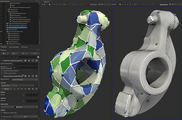
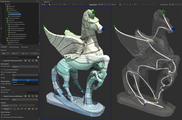
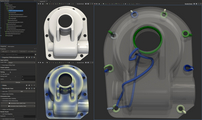
This tutorial introduces the foundations and practical applications of Topological Data Analysis (TDA) for surface meshes. TDA has emerged as a powerful framework for extracting robust, multi-scale structural features from complex data, making it particularly valuable for visualization, geometry processing, and scientific computing.
In this tutorial, participants will learn how to use the Topology Toolkit (TTK, https://topology-tool-kit.github.io/), a software library that provides a wide range of TDA algorithms for surface meshes, such as topological skeletonization and remeshing, the computation of persistent generators for detecting connectivity, loops, and holes, as well as topology-driven shape matching techniques. TTK is integrated into ParaView, which can be easily installed on Linux, Windows, and MacOS (https://www.paraview.org/download/). The tutorial is designed to be highly interactive, where attendees will engage in guided, hands-on exercises that teach them how to apply TDA methods within their own workflows.
Participants are asked to kindly bring their laptops and install paraview with the TTK-plugin in advance of the tutorial.
18:30 Welcome Reception (Foyer)
Wednesday, September 23
9:00 Welcome Address (US-C 116)
9:15 DAGM Award Session
11:00 - 12:00 GCPR Oral Session 1: Transfer Learning & Architectures (US-C 116)
Session Chair: Lukas Knobel
| Paper Title | Authors |
| Latent Space Representations Under Equivariance and Data Augmentation | Krishna Sri Ipsit Mantri; Gerrit Hübsch; Zorah Lähner |
| PURe: A Plug-and-Play Product-Unit Residual Module for Vision Networks | Ziyuan Li; Uwe Jaekel; Babette Dellen |
| Beyond Model Size: Probing the Gaps in Visual in-Context Learning by Training a Tiny Model | Sunil Khatri; Steven Landgraf; Markus Ulrich; Simon Reiß |
| Unlocking Pretrained Vision Transformers for Time Series Classification | Simon Roschmann; Quentin Bouniot; Vasilii Feofanov; Ievgen Redko; Zeynep Akata |
11:00 - 12:00 VMV Oral Session 1: Neural Rendering & Optics (US-C 115)
Session Chair: Vladislav Golyanik
| Paper Title | Authors |
| FrameDiffuser: G-Buffer-Conditioned Diffusion for Neural Forward Frame Rendering | Ole Beißwenger, Jan-Niklas Dihlmann, Hendrik Lensch |
| Neural Style Transfer for Data Encoding Using Strength Control | Niklas Merk, Anna Sterzik, Kai Lawonn |
| Kaleidoscopic Imaging for High-Speed 3D Tomographic Flame Reconstruction | Dhital Rajan, Ingo Schmitz, Thomas Seeger, Ivo Ihrke |
| Digital Encryption and Decryption of Plaintext Using Diffuser-Based Wave Optical Modeling and Optical Flow Neural Networks | Syed Muhammad Kazim, Rishikesh Kulkarni, Ivo Ihrke |
13:30 - 14:30 Keynote Talk: Niloy Mitra (US-C 116)
Session Chair: Volker Blanz
Beyond Pixels and Points: Explicit Control and Implicit Physics for 4D Generation
Abstract: The creation and understanding of 4D dynamics remain a key challenge spanning computer vision and graphics. However, modeling the temporal evolution of the 3D world requires balancing two competing factors: explicit representations that offer fine-grained control and structural fidelity, and implicit (neural) models that capture scalable and complex visual priors.
In this talk, I will discuss our efforts to bridge explicit and implicit paradigms to reconstruct, generate, and simulate 4D content. First, we will examine LooseControlVideo, demonstrating how we can condition large-scale implicit video generation models on rough, explicit 3D bounding boxes to achieve highly controllable dynamic scenes. Moving from generation to reconstruction, I will showcase how we can lift video priors into explicit, animated, and fully articulated 3D character meshes, capturing complex motion without multi-view setups. Finally, we will look beyond appearance toward underlying physical laws with Neural Voxel Dynamics. By building an implicit model of physics on top of V-JEPA feature spaces, I will describe the possibility of learning a generalized neural simulator. Together, these approaches sketch a possible trajectory towards 4D assets necessary to build fully controllable, physically grounded dynamic worlds.
Bio: Niloy J. Mitra leads the Smart Geometry Processing group in the Department of Computer Science at University College London and the Adobe Research London Lab. He received his Ph.D. from Stanford University under the guidance of Leonidas Guibas. His research develops machine learning frameworks for reconstructing/generating high-quality geometric and dynamic content in computer graphics applications. He has received several recognitions, including the ACM SIGGRAPH Significant New Researcher Award (2013), the BCS Roger Needham Award (2015), and the Eurographics Outstanding Technical Contributions Award (2019). He was elected a Eurographics Fellow in 2021, served as Technical Papers Chair for SIGGRAPH in 2022, and was inducted into the SIGGRAPH Academy in 2023. Beyond research, Niloy is an avid DIYer and enjoys reading, cricket, and cooking. More information is available at geometry.cs.ucl.ac.uk.
14:30 - 15:30 GCPR Oral Session 2: Generative & Latent Variable Models (US-C 116)
Session Chair: Natacha Kuete Meli
| Paper Title | Authors |
| Concept Guidance: Precise, Training-Free Latent Control for Text-to-Image Generation | Nikolai Röhrich; Isabell Hans; Felix Krause; Björn Ommer |
| VisDom: Sparse Novel View Synthesis with Visible Domain Constraint | Mariia Gladkova; Tarun Yenamandra; Edmond Boyer; Robert Maier; Tony Tung; Daniel Cremers |
| ManifoldSplat: Language-Guided Semantic Shape Editing of 3D Gaussian Head Avatars | Antonio Canela; Jordi Sànchez-Riera |
| Contrastive Energy Fields for Inference-Time Procedure Planning in Instructional Videos | Mohamed Afham Mohamed Aflal; Christoph Reich; Oliver Hahn; Daniel Cremers; Stefan Roth |
14:30 - 15:30 VMV Oral Session 2: Detection, Classification & Registration (US-C 115)
Session Chair: Dieter Schmalstieg
| Paper Title | Authors |
| MiDAS: A Mixed-Reality Annotation Solution for Pose Estimation and 2D Vision Tasks Using Foundation Models | Julius Kühn, I Kadek Jimmy Sardana, Fabian Rücker, Robin Horst, Arjan Kuijper |
| ELDA: GPU-Accelerated Elliptical Local-Distance Approximation | Katharina Krämer, Michael Kosterhon, Stefan Müller |
| ProtoP-3DOD: Prototype-based Interpretable 3D Object Detection for Automated Driving | Tarek Renusch |
| When Does Test-Time Augmentation Help Calibration? A Visual, Modality-Stratified Study for Medical Image Classification | Mohamed Hafez, Mustafa Eren Soyhan, Mohamed Ahmed, Sudha Rajendran, Thuy Trang Cao, Vaidehiben Patel, Khalid Elgazzar |
16:00 - 17:00 Poster Session 1: P1-P20 (Foyer) + P21-P26 (US-C 102)
| ID | Paper Title | Authors |
| P1-1 | Latent Space Representations Under Equivariance and Data Augmentation | Krishna Sri Ipsit Mantri; Gerrit Hübsch; Zorah Lähner |
| P1-2 | Confidence matters: Leveraging Multi-view Geometric Priors for GS-based Reconstruction | Hongyu Zhou; Zorah Lähner |
| P1-3 | Contrastive Energy Fields for Inference-Time Procedure Planning in Instructional Videos | Mohamed Afham Mohamed Aflal; Christoph Reich; Oliver Hahn; Daniel Cremers; Stefan Roth |
| P1-4 | PURe: A Plug-and-Play Product-Unit Residual Module for Vision Networks | Ziyuan Li; Uwe Jaekel; Babette Dellen |
| P1-5 | SmallDrive: An Efficient Vision-Language-Action Model for Autonomous Driving via Flow Matching | Atanas Poibrenski; Farzad Nozarian; Vahdat Abdelzad; Matthias Klusch; Christian Müller; Philipp Slusallek |
| P1-6 | Correlating Explainability and Predictive Uncertainty under Controlled Perturbations for Maritime Object Detection | Nico Jungbauer; Hai Huang; Martin Weinmann; Anton Schwertfeger; Helmut Mayer |
| P1-7 | ManifoldSplat: Language-Guided Semantic Shape Editing of 3D Gaussian Head Avatars | Antonio Canela; Jordi Sànchez-Riera |
| P1-8 | DINO-MT: Multi-Teacher Representation Learning for Remote Sensing | Marius Gehlhaus; Ronny Haensch |
| P1-9 | Beyond Model Size: Probing the Gaps in Visual in-Context Learning by Training a Tiny Model | Sunil Khatri; Steven Landgraf; Markus Ulrich; Simon Reiß |
| P1-10 | Doppio: A Dataset for Contactless Weight Estimation of Free-Falling Particles | Simon Kiefhaber; Jan-Martin Steitz; Julia Grabinski; Christoph Reich; Paul Wagner; Max Zimmermann; Simone Schaub-Meyer; Stefan Roth |
| P1-11 | Unlocking Pretrained Vision Transformers for Time Series Classification | Simon Roschmann; Quentin Bouniot; Vasilii Feofanov; Ievgen Redko; Zeynep Akata |
| P1-12 | VisDom: Sparse Novel View Synthesis with Visible Domain Constraint | Mariia Gladkova; Tarun Yenamandra; Edmond Boyer; Robert Maier; Tony Tung; Daniel Cremers |
| P1-13 | Depth-Wise Representation Development Under Blockwise Self-Supervised Learning for Video Vision Transformers | Jonas Römer; Timo Dickscheid |
| P1-14 | DynaEFace: Dynamic Efficient Facial Expression Recognition in the wild | Lynda Sayoud; Slimane Larabi |
| P1-15 | Mask What Matters: Saliency-Guided Video Self-Supervised Learning for Autonomous Driving | Christopher Lang; Alexander Braun; Abhinav Valada |
| P1-16 | SynSur: An end-to-end generative pipeline for synthetic industrial surface defect generation and detection | Paul Kühn; Mika Pommeranz; Neil Saptarshi Sinha; Arjan Kuijper |
| P1-17 | From Wrecks to Wisdom: Recovering Crash Mechanics from Real-World Multi-View Photos | Ondřej Valach; Václav Diviš; Ivan Gruber |
| P1-18 | MixMatchDet: Mixing and Matching Tokens for Plain ViT Detectors | David Rohrschneider; Anselm Haselhoff; Uwe Handmann |
| P1-19 | Structure-from-Motion Covisibility-Guided Semantic Seeding for Joint Photo-Semantic 3D Gaussian Splatting | Zakaria Lotfi; Amine Kaceta; Jérôme Royan; Panagiotis Papadakis |
| P1-20 | Concept Guidance: Precise, Training-Free Latent Control for Text-to-Image Generation | Nikolai Röhrich; Isabell Hans; Felix Krause; Björn Ommer |
| P1-21 | FaCT: Faithful Concept Traces for Explaining Neural Network Decisions | Amin Parchami-Aragh; Sukrut Rao; Jonas Fischer; Bernt Schiele |
| P1-22 | Neural Atlas Graphs for Dynamic Scene Decomposition and Editing | Jan Philipp Schneider; Pratik Singh Bisht; Ilya Chugunov; Andreas Kolb; Michael Möller; Felix Heide |
| P1-23 | F-INR: Functional Tensor Decomposition for Implicit Neural Representations | Tim Büchner; Joachim Denzler |
| P1-24 | On the Faithfulness of Post-Hoc Concept Bottleneck Models | Laines Schmalwasser; Jan Blunk; Niklas Penzel; Julia Niebling; Joachim Denzler |
| P1-25 | RobustSpring: Benchmarking Robustness to Image Corruptions for Optical Flow, Scene Flow and Stereo | Victor Oei; Jenny Schmalfuss; Lukas Mehl; Madlen Bartsch; Shashank Agnihotri; Margret Keuper; Andreas Bulling; Andrés Bruhn |
| P1-26 | QuCOOP: A Versatile Framework for Solving Composite and Binary-Parametrised Problems on Quantum Annealers | Natacha Kuete Meli; Vladislav Golyanik; Marcel Seelbach Benkner; Michael Moeller |
16:00 - 17:00 VMV Oral Session 3: Rendering & View Synthesis (US-C 115)
Session Chair: Marc Stamminger
| Paper Title | Authors |
| Fast Pseudo Caustics with Ray Differentials | Felix Brüll, René Kern, Thorsten Grosch |
| Fast Eye-Tracked 3D Gaussian Rendering for Virtual Reality | Timon Scholz, Florian Hahlbohm, Martin Eisemann, Susana Castillo, Marcus Magnor |
| Variance and Displacement Consistency Aware Densification for Gaussian Spaltting | Marco Bender, Pratik Singh Bisht, Andreas Kolb |
| Hybrid Latents: Geometry-Appearance-Aware Surfel Splatting | Neel Kelkar, Simon Niedermayr, Klaus Engel, Rüdiger Westermann |
17:00 - 17:30 VMV Nectar Session (Foyer)
| ID | Paper Title | Authors |
| P-1 | Canonical Rank Approximation (CaRA): An Efficient Fine-Tuning Strategy for Vision Transformers | Lokesh Veeramacheneni, Moritz Wolter, Hilde Kuehne, Juegen Gall |
| P-2 | Faster-GS: Analyzing and Improving Gaussian Splatting Optimization | Florian Hahlbohm, Linus Franke, Martin Eisemann, Marcus Magnor |
| P-3 | 3D sans 3D Scans: Scalable Pre-training from Video-Generated Point Clouds | Ryousuke Yamada, Kohsuke Ide, Yoshihiro Fukuhara, Hirokatsu Kataoka, Gilles Puy, Andrei Bursuc, Yuki M. Asano |
17:30-18:30 Industry Talks (US-C 115) Chair: Ivo Ihrke
Industrial challenges of AI and Machine Learning by Dr. Jascha Tempeler, Corporate Research and Technology, Carl Zeiss AG
Over the past decade, Machine Learning and Deep Learning have achieved remarkable breakthroughs. Yet state-of-the-art results on paper are no guarantee of success in practice. This talk will explore some of the challenges we face at ZEISS when translating research advances in Computer Vision into working solutions that create measurable added value in terms of precision, speed, reliability, and decision-making support for our customers. I will highlight real-world applications in domains that are hard to find on the Internet, where accurate representations of reality matter more than merely plausible looks, and where the clock is always ticking for your transformer model.
From research to venture by Navadha Malpani, Venture Capital Investor, Mätch VC
How do you turn deep tech research into a successful startup? What red flags do founders need to watch out for, and what challenges stand between research and venture? We talk about the obstacles that too often go unnoticed and the moment you actually know you're ready for a VC.
Towards causal foundation models for dynamical systems by Benjamin Herdeanu, Kausable AI
Human, technological, and natural systems evolve through complex causal interactions. Understanding and predicting their dynamics, often from limited observations and incomplete domain knowledge, calls for models that can generalize across systems rather than being trained for each problem from scratch. With CausalDynamics, we at kausable developed a comprehensive benchmark framework designed to rigorously evaluate state-of-the-art causal discovery algorithms for dynamical systems in order to facilitate the development of robust causal discovery algorithms. With TipPFN, we demonstrate robust, state-of-the-art early detection of critical transitions in previously unseen tipping regimes, sim-to-real examples, and real-world observations in both in-context learning and zero-shot settings.These works lay the foundation for capable causal foundation models for dynamical systems enabling learning from a few examples, conditioning on partial domain knowledge and hypothesis-driven scenario planning; all during inference without retraining.
18:30-20:00 Industry Fair (US-C Foyer)
Exhibitors:
- ZEISS
- Mätch VC
- Kausable AI
- K|Lens GmbH
- IGI mbH
- NEUROLOGIQ Engineering GmbH
- ifm efector gmbh
Thursday, September 24
9:00 - 9:45 PI Talk: Dagmar Kainmüller (US-C 116)
9:45 - 10:30 PI Talk: Anna Rohrbach (US-C 116)
11:00 - 12:00 GCPR Oral Session 3: 3D Reconstruction & Stereo (US-C 116)
Session Chair: Vladislav Golyanik
| Paper Title | Authors |
| Ordered Diffusion for 3D Human Registration | Mattia Masiero; Ilya Petrov; Daniel Cremers; Gerard Pons-Moll; Riccardo Marin |
| Pairwise Post-Hoc Cross-View Refinement of Monocular Metric 3D Geometry | Ulas Gunes; Matias Turkulainen; Mikhail Silaev; Juho Kannala; Esa Rahtu |
| SDFFormer: Robust Continuous Surface Extraction from Sparse Unposed Images via Learned Geometric Priors | Adrien Schockaert; Hazem Wannous; Guillaume Dufaye; Vincent Magnier; Jean-françois Witz |
| Perceptual Quality Densification for Gaussian Splatting | Olga Grebenkova; Dmytro Kotovenko; Ming Gui; Johannes Schusterbauer; Björn Ommer |
11:00 - 12:00 VMV Oral Session 4: Geometry (US-C 115)
Session Chair: Christian Rössl
| Paper Title | Authors |
| FittedGenes: Domain-Aware Sewing Pattern Layout Optimization | Ayşegül Barlas, Maria Korosteleva |
| Partial Symmetry Detection for 3D Geometry using Contrastive Learning with Geodesic Point Cloud Patches | Gregor Kobsik, Isaak Lim, Leif Kobbelt |
| Stroke Vectorization via Involution Prediction | Philipp Gerstner, Tanguy Magne, Olga Sorkine-Hornung |
| Robust Curvature-Driven Mesh Optimization | Leonard Fricke, Ulrich Schwanecke, Mario Botsch |
13:30 - 14:30 Keynote Talk: Felix Heide (US-C 116)
Session Chair: Andreas Kolb
14:30 - 15:30 GCPR Oral Session 4 Special Tracks (US-C 116)
Session Chair: Helmut Mayer
| Paper Title | Authors |
| Diffusion-Based SAR Training Data Synthesis Controlled by Spatial Annotations | Sylvia Hochstuhl; Horst Hammer; Antje Thiele; Tobias Brosch; Padraig Davidson; Tim Remiger; Michael Teutsch |
| EdgeISPNet : Ultra-Lightweight neural ISP for High-Resolution RAW-to-RGB High Altitude Imaging Systems | Sandeep Kumar Jangir; Sandeep Kumar Jangir; Reza Bahmanyar; Veronika Gstaiger |
| FireComp: Global Wildfire Dataset and Benchmark | Justus Karlsson; Yonghao Xu; Amanda Berg; Leif Haglund |
| From Heat to Force: Retrospective Estimation of Finger Contact Forces from Thermal Signatures | Arnold Schwarz; Levente Hernadi; Steffen Puhlmann; Nils Harnischmache; Erik Rodner; Hannes Höppner; Kristian Hildebrand |
14:30 - 15:30 VMV Oral Session 5: Visual Data Analysis (US-C 115)
Session Chair: Johanna Schmidt
| Paper Title | Authors |
| 2D versus 2.5D Layer Arrangement for Animal Behaviour Multiplex Networks | Stefan Paul Feyer, Karsten Klein, Stephen Kobourov, Katherine Snell, Natalia Borrego, Genevieve Erin Finerty, Rob S.A. van Bemmelen, Nina J O'Hanlon, Uakendisa Muzuma, Falk Schreiber |
| Design and Evaluation of Fractal Shapes for Hierarchy Node Identification | Tobias Mertz, Steven Lamarr Reynolds-Ringer, Maria Borchert, Lasse Zimmer, Jörn Kohlhammer |
| DEXPRO – Visual Data Explorer for Production and Design Data | Florian Steinwidder, Julian Rakuschek, Marcel Wuwer, Markus Brillinger, Ursula Augsdörfer, and Tobias Schreck |
| Parallel vs. Radial Axis Layouts in Parallel Coordinates | Gabriel Borrelli, Lars Linsen |
16:00 - 17:00 Poster Session 2: P1-P20 (Foyer) + P21-P26 (US-C 102)
| ID | Paper Title | Authors |
| P2-1 | Pairwise Post-Hoc Cross-View Refinement of Monocular Metric 3D Geometry | Ulas Gunes; Matias Turkulainen; Mikhail Silaev; Juho Kannala; Esa Rahtu |
| P2-2 | Ordered Diffusion for 3D Human Registration | Mattia Masiero; Ilya Petrov; Daniel Cremers; Gerard Pons-Moll; Riccardo Marin |
| P2-3 | Diffusion-Based SAR Training Data Synthesis Controlled by Spatial Annotations | Sylvia Hochstuhl; Horst Hammer; Antje Thiele; Tobias Brosch; Padraig Davidson; Tim Remiger; Michael Teutsch |
| P2-4 | STIP+: Context-Aware Human–Object Interaction Detection with Adaptive Relation Sampling | Yanxi Lin; Noha Sarhan; Simone Frintrop |
| P2-5 | SDFFormer: Robust Continuous Surface Extraction from Sparse Unposed Images via Learned Geometric Priors | Adrien Schockaert; Hazem Wannous; Guillaume Dufaye; Vincent Magnier; Jean-François Witz |
| P2-6 | FireComp: Global Wildfire Dataset and Benchmark | Justus Karlsson; Yonghao Xu; Amanda Berg; Leif Haglund |
| P2-7 | MHA-Track: Multi-Horizon Association for Vehicle Tracking in Low-Frame-Rate Aerial Imagery | Manuel Mühlhaus; Reza Bahmanyar; Franz Kurz; Friedrich Fraundorfer |
| P2-8 | AnchorDepth: Architectural Size Priors for Monocular Metric Depth via Anchor-Conditioned Scale Fields | Fuad Hasan; Chul Min Yeum; Bruce MacVicar |
| P2-9 | ChiralSPE: Benchmarking Trustworthiness and Symmetry in Atomistic Foundation Models based on OMol25 | Smith Pataraprasitpon |
| P2-10 | Cloud Masking in Polar Regions with Sensor-agnostic Visual Foundation Models for Hyper- and Multispectral Satellite Imagery | Tianyi You; Benjamin Busam |
| P2-11 | From Heat to Force: Retrospective Estimation of Finger Contact Forces from Thermal Signatures | Arnold Schwarz; Levente Hernadi; Steffen Puhlmann; Nils Harnischmache; Erik Rodner; Hannes Höppner; Kristian Hildebrand |
| P2-12 | Learning Where to Focus: Self-Supervised Multi-Scale ViTs for Histopathology | Anabel Stammer; Valay Bundele; Mehran Hosseinzadeh; Hendrik Lensch |
| P2-13 | MeSS: City Mesh-Guided Outdoor Scene Generation with Cross-View Consistent Diffusion | Xuyang Chen; Zhijun Zhai; Kaixuan Zhou; Zengmao Wang; Jianan He; Dong Wang; Yanfeng Zhang; Mingwei Sun; Xuqin Wang; Rüdiger Westermann; Tao Wu; Konrad Schindler; Liqiu Meng |
| P2-14 | Multi-Person Human Motion Forecasting in Complex Scenes | Serdar Ozsoy; Lars Doorenbos; Juergen Gall |
| P2-15 | Mixture of Geographical Experts: Disentangling Earth | Moien Rangzan; Gregory Duveille; Maha Shadaydeh; Markus Reichstein; Joachim Denzler |
| P2-16 | Perceptual Quality Densification for Gaussian Splatting | Olga Grebenkova; Dmytro Kotovenko; Ming Gui; Johannes Schusterbauer; Björn Ommer |
| P2-17 | Cytoarchitecture in Words: Weakly Supervised Vision–Language Modeling for Human Brain Microscopy | Matthew Sutton; Katrin Amunts; Timo Dickscheid; Christian Schiffer |
| P2-18 | EdgeISPNet : Ultra-Lightweight neural ISP for High-Resolution RAW-to-RGB High Altitude Imaging Systems | Sandeep Kumar Jangir; Sandeep Kumar Jangir; Reza Bahmanyar; Veronika Gstaiger |
| P2-19 | Physics-Aligned Self-Supervised Learning for Scientific Imaging | Bashir Kazimi; Stefan Sandfeld |
| P2-20 | 3D-WAG: Hierarchical Wavelet-Guided Autoregressive Generation for High-Fidelity 3D Shapes | Tejaswini Medi; Margret Keuper |
| P2-21 | Laplace-Beltrami Operator for Gaussian Splatting | Hongyu Zhou; Zorah Lähner |
| P2-22 | Align Once to Explain: Feature Alignment for Scalable B-cosification of Foundational Vision Transformers | Raphael Maser; Siddhartha Gairola; Sukrut Rao; Bernt Schiele |
| P2-23 | MoAngelo: Motion-Aware Neural Surface Reconstruction for Dynamic Scenes | Mohamed Ebbed; Zorah Lähner |
| P2-24 | Locally Explaining Prediction Behavior via Gradual Interventions and Measuring Property Gradients | Niklas Penzel; Joachim Denzler |
| P2-25 | A Bit is All You Need! Efficient Video Capture via Single Bit Imaging | Kanchana Vaishnavi Gandikota; Michael Möller; Andreas Kolb; Bhaskar Choubey; Paramanand Chandramouli |
| P2-26 | RAWDet-7: A Multi-Scenario Benchmark for Object Detection and Description on Quantized RAW Images | Mishal Fatima; Shashank Agnihotri; Kanchana Vaishnavi Gandikota; Michael Möller; Margret Keuper |
17:45–18:00: Bus Transfer
From City Center (Koblenzer Straße 40, 57072 Siegen) to Dorint Parkhotel
19:00–01:30: Conference Dinner
(Dorint Parkhotel Siegen, Patmosweg 60, 57078 Siegen)
22:00–01:30: Bus Transfer: From Dorint Parkhotel to City Center
Friday, September 25
9:00 - 9:45 PI Talk: Björn Ommer (US-C 116)
9:45 - 10:30 PI Talk: Justus Thies (US-C 116)
11:00 - 12:00 Poster Session 3: P1-P20 (Foyer) + P21-P26 (US-C 102)
| ID | Paper Title | Authors |
| P3-1 | SceneTok: A Compressed, Diffusable Token Space for 3D Scenes | Mohammad Asim; Christopher Wewer; Jan Eric Lenssen |
| P3-2 | CPUBone: Efficient Vision Backbone Design for Devices with Low Parallelization Capabilities | Moritz Nottebaum |
| P3-3 | Symmetry Informative and Agnostic Feature Disentanglement for 3D Shapes | Tobias Weißberg; Weikang Wang; Paul Roetzer; Nafie El Amrani; Florian Bernard |
| P3-4 | An Integrated Algorithm For Single Lead Electrocardiogram Signal Analysis Using Deep Learning With 12-Lead Data | Muhammad Farhan Safdar |
| P3-5 | Gradient Extrapolation for Debiased Representation Learning | Ihab Asaad |
| P3-6 | CFM: Language-aligned Concept Foundation Model for Vision | Kai Wittenmayer; Sukrut Rao; Amin Parchami-Araghi; Bernt Schiele; Jonas Fischer |
| P3-7 | RamPINN: Recovering Raman Spectra From Coherent Anti-Stokes Spectra Using Embedded Physics | Adithya Ashok Chalain Valapil; Sai Karthikeya Vemuri; Tim Büchner; Joachim Denzler |
| P3-8 | Cycle-Consistent Multi-Graph Matching for Self-Supervised Annotation of C. Elegans | Sebastian Stricker; Christoph Karg; Lisa Hutschenreiter; Bogdan Savchynskyy; Dagmar Kainmueller |
| P3-9 | The Gaussian Discriminant Variational Autoencoder (GdVAE): A Self-explainable Model with Counterfactual Explanations | Anselm Haselhoff; Kevin Trelenberg; Fabian Küppers; Jonas Schneider |
| P3-10 | Distance-informed Neural Processes | Aishwarya Venkataramanan; Joachim Denzler |
| P3-11 | Modality-Aware Out-of-Distribution Detection for Multi-Modal Action Recognition | Lars Doorenbos; Duc Manh Vu; Serdar Ozsoy; Juergen Gall |
| P3-12 | Unsupervised Pixel-Level Semantic Left-Right Understanding of In-the-Wild Images | Weikang Wang; Tobias Weißberg; Florian Bernard |
| P3-13 | GeoDiv: Framework for Measuring Geographical Diversity in Text-to-Image Models | Abhipsa Basu; Mohana Singh; Shashank Agnihotri; Margret Keuper; Venkatesh Babu Radhakrishnan |
| P3-14 | Feature-Preserving Mesh Decimation for Normal Integration | Moritz Heep; Sven Behnke; Eduard Zell |
| P3-15 | TCD-Arena: Assessing Robustness of Time Series Causal Discovery Methods Against Assumption Violations | Gideon Stein |
| P3-16 | Steerable Visual Representations | Jona Ruthardt; Manu Gaur; Deva Ramanan; Makarand Tapaswi; Yuki Asano |
| P3-17 | Dynamic Inverse Rendering for Enhanced Material-Lighting Decomposition | Raza Yunus; Benjamin Ummenhofer; Jan Eric Lenssen; Eddy Ilg |
| P3-18 | Franca: Nested Matryoshka Clustering for Scalable Visual Representation Learning | Shashanka Venkataramanan; Valentinos Pariza; Mohammadreza Salehi; Lukas Knobel; Elias Ramzi; Spyros Gidaris; Andrei Bursuc; Yuki Asano |
| P3-19 | SOTAlign: Semi-Supervised Alignment of Unimodal Vision and Language Models via Optimal Transport | Simon Roschmann; Paul Krzakala; Sonia Mazelet; Quentin Bouniot; Zeynep Akata |
| P3-20 | DeepConvContext: A Multi-Scale Approach to Timeseries Classification in Human Activity Recognition | Marius Bock, Juergen Gall, Michael Möller, Kristof Van Laerhoven |
| P3-21 | Surface activity identification in 4D point clouds using temporal CNNs for semantic segmentation | Jakob Kuhn; Jiapan Wang; Katharina Anders; Mathilde Letard |
| P3-22 | On the Feasibility of Vision Foundation Models on Astrophysical X-Ray Data | Ina Taxis; Jakob Dietl; Will McDonald; Thomas Reiprich; Zorah Lähner |
| P3-23 | Compressing Deep Reinforcement Learning via Evolving Target Sparsity | Rachana Tirumanyam; André Biedenkapp; Jovita Lukasik |
| P3-24 | Towards One-Shot Prediction of Optimal Camera Parameters for Image Classification | Kalyani Rameshan Nambiar; Jerin Paul; Sanjay Suresh; Jan Philipp Schneider; Michael Möller |
| P3-25 | From Laboratory to Road: Evaluating Wearable Gaze Accuracy for Driving | William Engel; Fabian Flohr |
| P3-26 | Drainage: A Unifying Framework for Addressing Class Uncertainty | Yasser Taha, Grégoire Montavon, Nils Körber |
11:00 - 12:00 VMV Oral Session 6: Time-dependent Data (US-C 115)
Session Chair: Lars Linsen
| Paper Title | Authors |
| Upsampling of Lagrangian Particle Simulations | Timna Böttcher, Hans Nußpickel, Jan Bender |
| Progressive Visual Segmentation of Vibration Signals to Detect Change Points | Julian Rakuschek, Johanna Schmidt, Udo Schlegel, Michèle Posch, Jutta Isopp, Tobias Schreck |
| Automatic Motion Lines for Animated Surface Meshes | Markus Pawellek, Anna Sterzik, Kai Lawonn |
| Visual Analysis of Uncertain Patterns in Highly Variable Ensembles Using EOFs - Winter Water Vapor Transport in Europe under Climate Change | Tomas Daetz, Christian Heine, Michael Böttinger, Denis Streitmatter, Gerik Scheuermann, Baldwin Nsonga |
13:30 - 14:30 Keynote Talk: Elisa Ricci (US-C 116)
Session Chair: Michael Möller